
Madagascar
Madagascar vanilla, from flower to bean
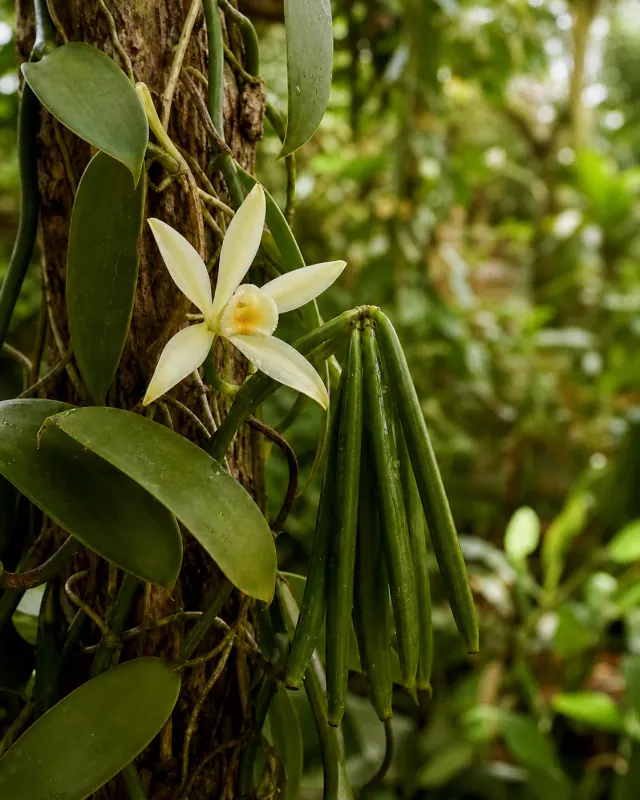
Madagascar is the world’s leading source of natural vanilla and the best-known origin for Bourbon vanilla. The final bean is the result of hand pollination, eight to nine months of maturation and a long sequence of curing operations.
This guide explains what Bourbon means, where vanilla is grown, how aroma develops and why vanillin is useful without being a complete quality score.
- Vanilla planifolia and the Bourbon tradition
- Hand pollination and months of preparation
- Regions, vanillin, selection and storage
- Main species
- Vanilla planifolia
- Flower to harvest
- About 8 to 9 months
- Historic method
- Bourbon curing
- Major basin
- SAVA, north-east Madagascar
From Mexico to Madagascar: key dates
Vanilla planifolia comes from tropical America, from southern Mexico to Central America. The Totonac people, notably around Papantla, knew and prepared vanilla before Europeans arrived. The Aztecs also received it as tribute and used it in cocoa drinks.
- Before 1519 · Mexico — The Totonac people know and prepare vanilla. In the fifteenth century, the Aztecs receive it as tribute and use it with cocoa.
- Sixteenth century · Europe — Cortés arrives in Mexico in 1519. Following the Spanish conquest, vanilla reaches Spain and spreads through Europe during the sixteenth century.
- 1819–1822 · Bourbon Island — Several introductions take place on what is now Réunion. In 1822, Vanilla planifolia plants brought from the Paris natural history museum become established.
- 1836 · Liège — Belgian botanist Charles Morren obtains vanilla fruits through artificial pollination in the Liège greenhouses.
- 1841 · Bourbon Island — Edmond Albius, a twelve-year-old enslaved child, develops a quick, repeatable hand-pollination technique. Its principle is still used in plantations.
- 1870s–1880s · Madagascar — Plants and techniques arrive from Réunion, notably in Nosy Be and then Sainte-Marie. Cultivation later spreads along the east coast and into the north-east towards the end of the nineteenth century.
Definition
Madagascar and Bourbon do not mean exactly the same thing
“Madagascar vanilla” states the country of origin. “Bourbon vanilla” is a historical term associated with Vanilla planifolia grown and cured in the Indian Ocean, particularly Madagascar, Réunion and the Comoros.
Bourbon is not another botanical species and has nothing to do with American bourbon whiskey. Its commercial strength comes from a familiar, balanced aromatic profile and a curing tradition refined over generations.
Flower and fruit
Pollinated by hand, one flower at a time
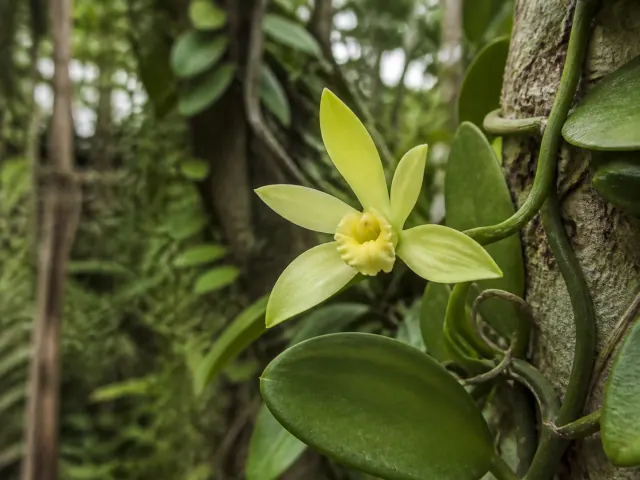
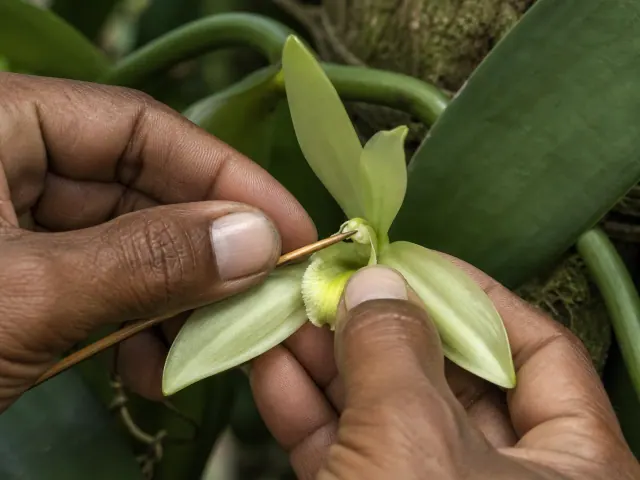
A membrane called the rostellum separates the male and female parts of the flower. In Madagascar, natural fruit set is too rare for regular commercial production, so workers pollinate the flowers by hand during the few hours when they are receptive.
After successful pollination, the green capsule grows quickly and then matures on the vine for roughly eight to nine months. A slight yellowing at the tip is one sign used to guide a careful harvest.
This hand-pollination gesture is also known in French as the “mariage de la vanille”, or vanilla marriage. Fertilisation then takes place inside the flower.
- The flower is receptive for only a short period
- Pollination is performed in the morning, flower by flower
- Capsules do not all mature on the same day
- Harvest therefore requires several passes through the plot
Curing
The aroma is built after harvest
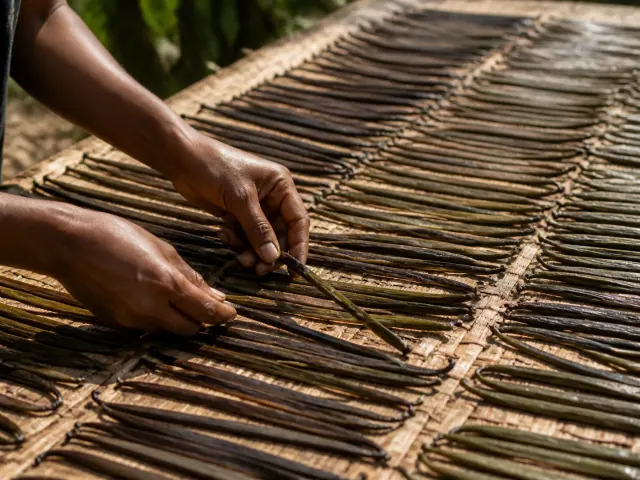
A green capsule is firm and only faintly aromatic. The Bourbon process generally combines scalding, sweating, short periods of sun drying, slower shade drying, conditioning in boxes and final sorting.
These operations lower moisture gradually and allow enzymatic and chemical reactions to release and transform aromatic compounds. Rushing the process can flatten the profile or create defects.
- Scalding starts the transformation
- Sweating browns and softens the fruit
- Sun and shade drying reduce moisture progressively
- Conditioning develops and stabilises the bouquet
Geography
Several producing regions, not one uniform terroir
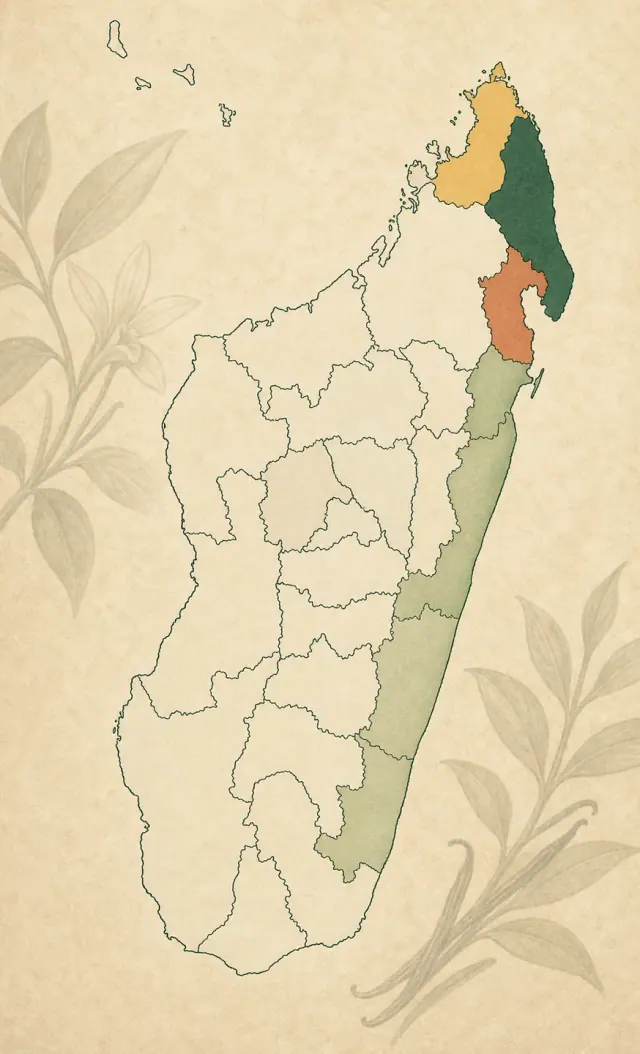
SAVA in the north-east, around Sambava, Antalaha, Vohémar and Andapa, is Madagascar’s main historic vanilla basin. Production also exists in DIANA around Ambanja and Nosy Be, in Ambatosoa, and along parts of the east and south-east coasts.
Climate, shade, plant material, harvest calendars and curing practices can influence a batch. A regional name is useful information, but it does not automatically prove a separate botanical variety or a superior grade.
The map identifies broad growing areas. It does not represent production volumes or planted surface.
Aromatic indicator
What the vanillin percentage really measures
Vanillin is one of the main aroma compounds in prepared Vanilla planifolia. In the green fruit it is largely stored as glucovanillin; during curing, beta-glucosidase helps release vanillin and glucose.
A percentage expresses the mass of vanillin relative to the analysed sample. A result on a dry-matter basis cannot be compared directly with a result on an as-is bean, because moisture changes the denominator.
- Published analyses of good prepared Vanilla planifolia often approach 2%, and some high-grade samples are reported around 2 to 2.5%, depending on method and calculation basis
- Only an analysis tied to a specific batch can certify that batch
- A strong result supports a premium positioning
- It still does not describe all floral, woody, fruity or spicy notes
To compare two figures, check the analytical method, moisture, calculation basis and preparation stage.
Strengths and uses
Why Madagascar Bourbon remains the benchmark
A well-prepared Madagascar Bourbon bean is prized for a broad, recognisable profile, often described as creamy, warm and woody, with cocoa, honey or dried-fruit nuances. Its balance makes it versatile rather than limited to one recipe.
Whole beans provide seeds and a pod wall for long infusion. Extract is convenient for repeatable dosing. The preferred format depends on whether the goal is visual seeds, slow infusion or quick, consistent flavouring.
- Custards, ice cream and pastry creams
- Cakes, biscuits and chocolate
- Syrups, coffee and cold drinks
- Infused rum and savoury marinades
Buying and storage
Choose the bean, not just the label
Look for a supple, fleshy bean with a clean aroma and a healthy surface. Length is commercially useful, but a long dry bean is not automatically better than a shorter, well-cured one.
Store beans in a clean, tightly closed container away from heat, direct light and condensation. Avoid the refrigerator unless the producer specifically recommends it, as temperature changes can encourage condensation.
- Check flexibility and aroma
- Ask about origin and preparation when available
- Follow the packaging instructions
- Use opened beans promptly and keep the container clean
FAQ
Madagascar vanilla, from flower to bean
Why is vanilla pollinated by hand in Madagascar?
The rostellum separates the flower’s reproductive parts, and natural fruit set is too rare for regular production. Workers bring the pollinia and stigma together by hand during the short flowering window. This is the gesture known as the “mariage de la vanille”.
Is Bourbon vanilla a different species?
No. Bourbon usually refers to Vanilla planifolia grown and cured in the Indian Ocean. It is a historical and commercial term, not a separate species.
Does a higher vanillin percentage always mean better vanilla?
It is a valuable indicator of aromatic richness, but not a complete score. Moisture, maturity, flexibility, curing and many other aroma compounds also shape quality.
Is all Madagascar vanilla identical?
No. Plant material, region, weather, harvest maturity and curing decisions can all change the final profile, even within the same species.
What are Madagascar’s main producing areas?
SAVA is the principal historic basin. Vanilla is also cultivated in DIANA and Nosy Be, Ambatosoa, Analanjirofo and other parts of the east and south-east coasts.
How long does vanilla take to reach harvest?
The capsule generally remains on the vine for about eight to nine months after pollination before careful harvesting begins.
How should vanilla beans be stored?
Use a clean, tightly closed container and keep it away from heat, light and condensation. Packaging instructions remain the first reference.
Sources and method
- 01 · Kew Gardens, vanilla botany
- 02 · Rasoamanalina et al., genetic diversity in Madagascar
- 03 · Tran et al., aroma composition by species and origin
- 04 · FAO, vanilla post-harvest compendium
- 05 · World Bank, sustainable vanilla cultivation guide
- 06 · Archives and Villèle Museum, Edmond Albius and vanilla introductions to Bourbon
- 07 · Bouriquet, vanilla cultivation in Madagascar, 1946
- 08 · Cirad, hand pollination and the vanilla marriage in Réunion
- 09 · Mexican Ministry of Education, Totonac people and vanilla uses
- 10 · INAH, Cortés arrives in Veracruz in 1519
- 11 · French National Museum of Natural History, Morren and Albius